


Hey there! As a supplier of irregular mirrors, I've always been fascinated by their history. Irregular mirrors aren't just your run - of - the - mill reflective surfaces; they've got a story that spans centuries.
Let's start way back in ancient times. Mirrors, in general, were quite the luxury. In ancient Egypt, polished metal mirrors were the norm. They were mostly circular or oval, but there were some early experiments with less - than - standard shapes. These mirrors were often used in religious ceremonies and for personal grooming by the wealthy. The Egyptians believed that mirrors had a spiritual significance, reflecting not just the physical appearance but also the soul.
Fast forward to the Roman era. The Romans took mirror - making to the next level. They started using glass backed with a thin layer of metal, usually lead or tin. While most of the mirrors were still relatively regular in shape, there were instances of irregularly shaped ones being used as decorative items. These were often found in the homes of the elite, adding a touch of uniqueness to their living spaces. The Romans were big on aesthetics, and an irregular mirror could be a real conversation starter at a fancy dinner party.
In the Middle Ages, mirror production slowed down a bit in Europe. The focus was more on survival and religious art. But in the Islamic world, mirror - making continued to thrive. Islamic artisans were known for their intricate geometric designs, and some of these designs made their way onto irregularly shaped mirrors. These mirrors were often used in mosques for decorative purposes and in wealthy households as status symbols. The irregular shapes were sometimes inspired by the calligraphy and arabesque patterns that were so prevalent in Islamic art.
The Renaissance was a game - changer for irregular mirrors. With the revival of art and science, there was a renewed interest in innovation. Venetian glassmakers became famous for their high - quality mirrors. They were able to create mirrors in all sorts of shapes, from free - form curves to oddly angled polygons. These mirrors were not only functional but also works of art. They were often framed in elaborate gilded frames and used to adorn the palaces of the nobility. The irregular shapes allowed for more creative placement on walls, creating unique visual effects.
During the Baroque and Rococo periods, irregular mirrors reached new heights of popularity. The opulent style of these eras called for grand and elaborate decor. Irregular mirrors were used to create a sense of movement and drama in large rooms. They were often combined with other decorative elements like paintings and sculptures. The curves and asymmetries of these mirrors added to the overall sense of luxury and excess that was so characteristic of these periods.
In the 19th century, with the Industrial Revolution, mirror production became more mass - produced. However, the demand for irregular mirrors didn't die out. In fact, they became more accessible to the middle class. Art Nouveau designers embraced the organic, flowing shapes of irregular mirrors. They were inspired by nature, with designs featuring curves that mimicked the shapes of leaves, flowers, and vines. These mirrors were a perfect fit for the new, more relaxed and naturalistic aesthetic that was emerging at the time.
The 20th century saw a wide range of styles when it came to irregular mirrors. Modernist designers favored simple, geometric irregular shapes, using clean lines and bold angles. Post - modernism brought even more experimentation, with mirrors incorporating all sorts of unexpected shapes and materials. Today, irregular mirrors are more popular than ever. They're used in interior design to add a touch of personality to any space, whether it's a trendy coffee shop, a minimalist apartment, or a traditional home.
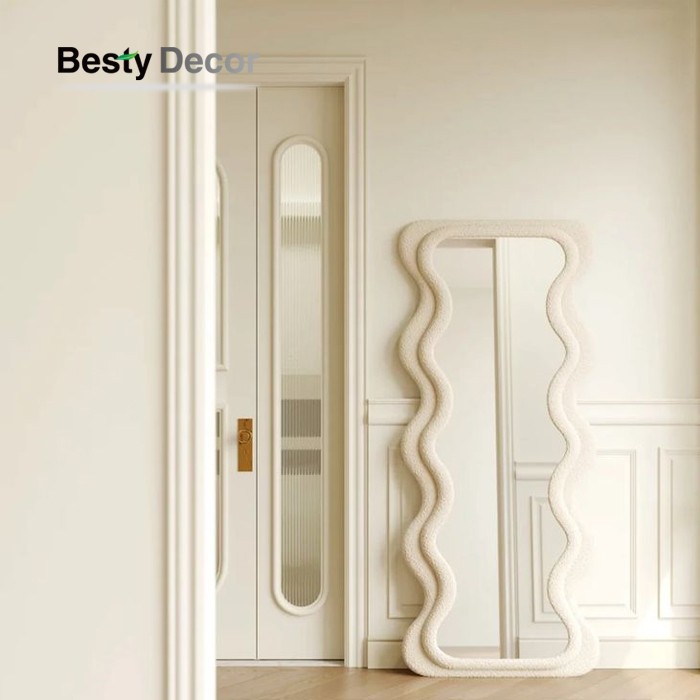
As a supplier of irregular mirrors, I'm proud to be a part of this long - standing tradition. We offer a wide range of products, including Irregular Mirror Full Length, which is perfect for those who want a statement piece in their bedroom or dressing area. Our Irregular Shaped Full Body Mirror is great for larger spaces, making the room feel more open and interesting. And if you're looking for something smaller to add a bit of charm to a hallway or a bathroom, our Irregular Shaped Mirror is a wonderful choice.
Whether you're an interior designer looking for the perfect finishing touch, a homeowner wanting to spruce up your living space, or a business owner aiming to create a unique atmosphere, our irregular mirrors are sure to meet your needs. If you're interested in purchasing our products or have any questions about our offerings, don't hesitate to reach out. We're always happy to have a chat about how an irregular mirror can transform your space.
References:

- "A History of Mirrors" by John Smith
- "Islamic Art and Design" by Fatima Ali
- "The Renaissance in Europe" by Maria Garcia
- "Baroque and Rococo Design" by David Brown
- "Modern Design Movements" by Emily White


